

![Australian Property Data API: 173 Endpoints, Free to Try [2026]](/images/blog/blog-data-dashboard.jpg)
Australian property data has been hard to buy for a long time. The incumbents sell annual contracts with minimum commitments, take weeks to onboard you, and will not tell you the price until you have spoken to sales. If you are building a tool, running a brokerage, or just testing an idea, that is a wall before you have written a line of code.
The Microburbs API is the opposite of that. Published prices, a key you mint yourself, and a sandbox you can call this minute without an account.
What data does the Australian property API cover?
173 endpoints over 90M+ property records, covering every Australian address and locality:
- Property — automated valuations with confidence intervals, sale and rent history, comparable sales, land values, bed/bath/car/land attributes, neighbours and street profiles
- Suburb — median prices and rents as time series, growth, yields, days on market, vacancy, stock on market, months of supply, transaction volumes, mortgage stress
- Demographics — income, age, tenure, occupation, ancestry, unemployment, down to mesh-block resolution
- Risk — flood, bushfire, landslide, erosion, heritage, high-voltage powerlines, noise, public housing proximity
- Development — zoning, building controls, development applications, construction activity and new supply
- Schools — catchments, rankings, proximity
- Suburb Finder — server-side ranking and filtering across all 15,000-odd localities on any numeric criteria
Is there a free Australian property data API?
The literal string test is a working API key. It is never billed and needs no account:
curl 'https://api.microburbs.com.au/v1/suburbs/Bondi/profile' -H 'Authorization: Bearer test'
That returns real data, not a stub. The sandbox covers one sample suburb and one sample property per state — Bondi, Belmont North, St Kilda (Vic.), Fortitude Valley, Subiaco, Unley, Sandy Bay, Kambah and Nightcliff. These are ABS Suburb and Locality names, so the state suffix matters where there is one. The suburb and property endpoints all work against them, so you can build and test an integration before paying anything; Suburb Finder search is outside the sandbox and needs a key. Swap in your own key and the same code covers the country.
How much does an Australian property data API cost?
Per call, in cents, and the rate card is public. No minimums, no annual commitment, no sales call. Most calls sit around 10c — that is the median for both suburb and property endpoints, and it is what an automated valuation costs. The expensive ones are the composites that do a lot of work: a full school catchment with geometry is $2.05, a whole market bundle $1.08. Eight endpoints are free, including suburb name resolution and the Suburb Finder's field and region catalogues, so working out what to call never costs anything.
Every response carries what it cost you, so there is never a surprise at the end of the month:
X-Cost-Cents— what this call costX-Spent-Cents— cumulative spendX-Remaining-Cents— prepaid credit left; calls stop when it hits zeroX-Request-Id— quote it in a support ticket
OpenAPI 3.1 spec, response envelope and SDKs
The whole surface is described in an OpenAPI 3.1 spec at https://api.microburbs.com.au/openapi.json, prices included. Point a client generator at it, or hand it to a coding agent and let it write the integration.
Responses use one envelope, so you branch on a single field rather than special-casing each endpoint:
{"data": {...}} when there is data, and {"data": null, "available": false, "reason": "..."} when there is not. Both are HTTP 200 — no data is a fact about the world, not an error. A 402 means you are out of credit, a 403 means the sandbox key hit something outside its allowance.
Does it work with AI agents? (MCP server included)
The same endpoints are exposed as an MCP server at https://api.microburbs.com.au/mcp, so Claude, Claude Code, Cursor, VS Code and Codex can call them as tools. Same key, same prices, same data — MCP is just another transport. It is listed in the official Model Context Protocol registry as au.com.microburbs/property-data.
That matters more than it sounds. It means you can prototype conversationally — ask Claude to pull the numbers, see the shape of the answer — and then write the integration against the REST API once you know what you need.
Who uses an Australian property data API
- Buyer's agents — shortlist suburbs on yield, growth and supply, then pull comparables for the ones that survive
- Brokers and lenders — valuation checks and risk overlays inside an existing origination flow
- Proptech — suburb and property enrichment behind your own product, without building a data team
- Agencies — automated CMAs and listing appraisals from live comparable sales
- Research — suburb and mesh-block metrics for modelling and dashboards. What you may do with the data is set out in the API terms
The developer portal: keys, usage and a cap so nothing runs away
Per-call billing raises one question before any other: what happens if my code loops overnight. Everything that answers it lives in the developer portal, and you do not need to email anyone to use it.
API keys. Generate, view and revoke them yourself at /developers/keys. Revocation takes effect immediately, so a leaked key is a thirty-second problem rather than a support ticket.
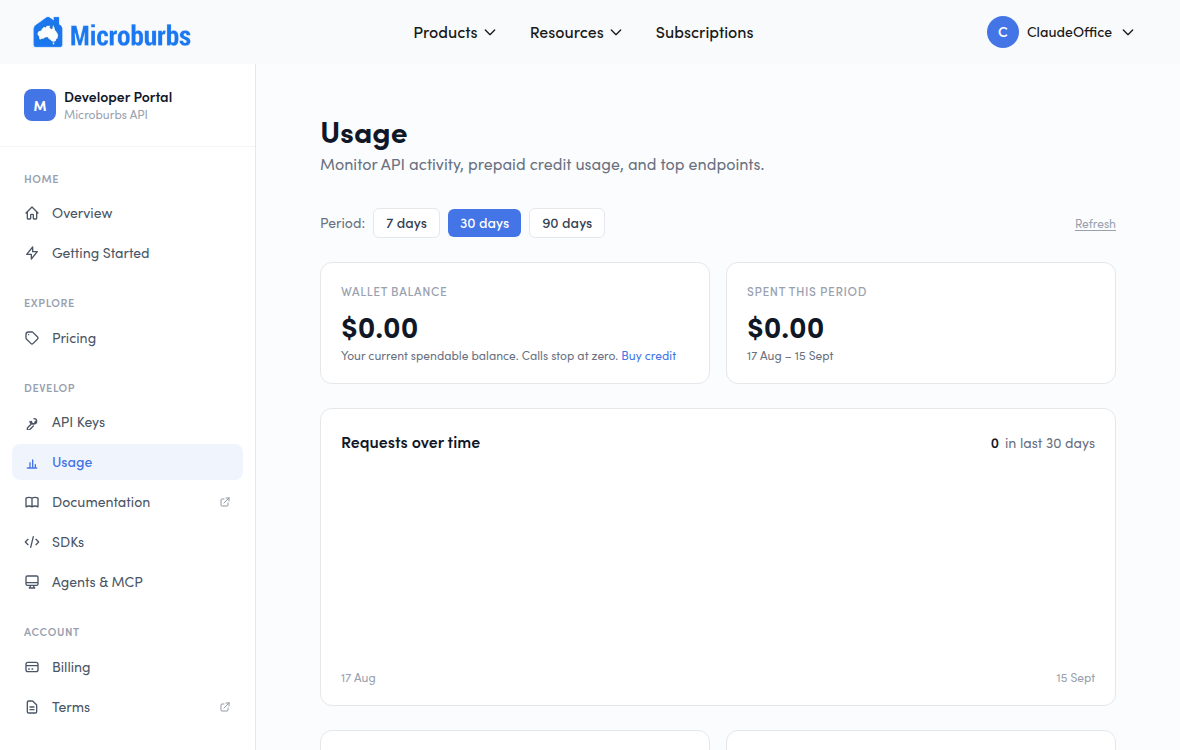
Usage. /developers/usage shows your balance, your call volume over 7, 30 or 90 days, and which endpoints are costing you the most. That last one matters more than it sounds — when a bill looks wrong it is almost always one expensive endpoint being called in a loop, and the table names it.
Billing, with the two controls that matter. The API is prepaid: you buy credit and calls draw it down. At /developers/billing you can set an automatic top-up — refill when the balance drops below an amount you choose — and a maximum spend per day. The cap is the important one. It is the difference between a runaway script costing you ten dollars and costing you a thousand, and it is the control most metered APIs make you ask for.
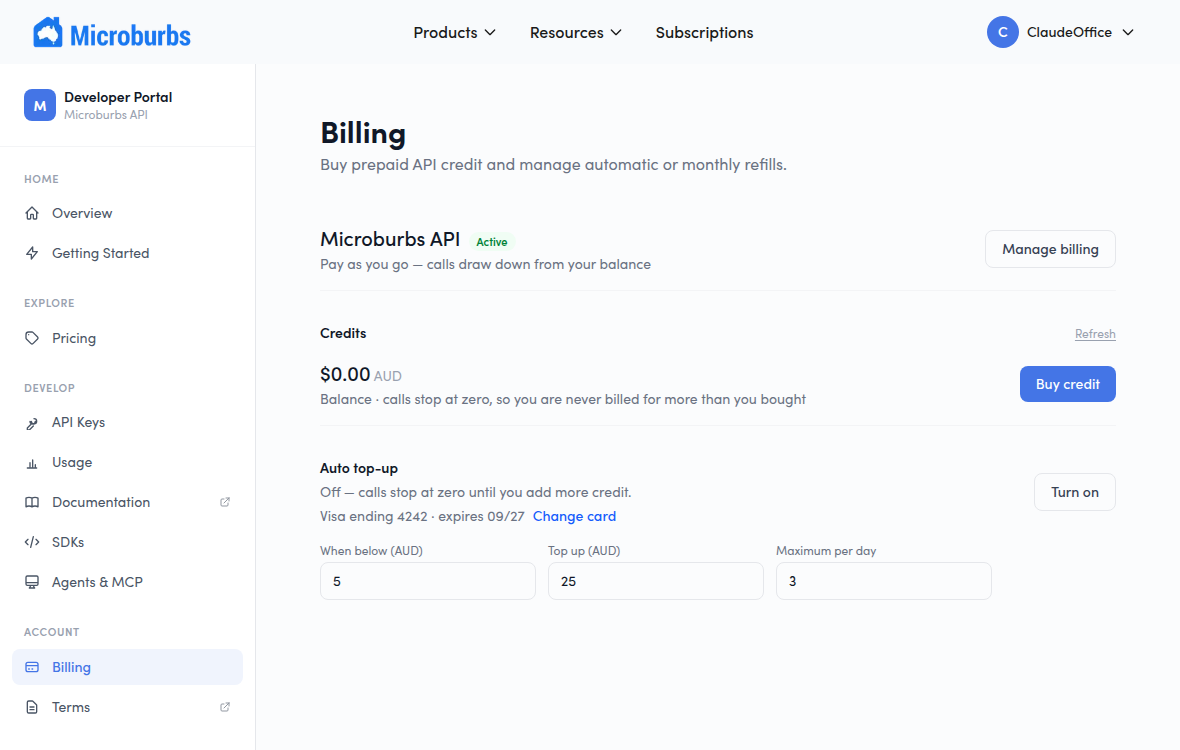
There is no invoice at the end of the month for calls you did not expect, because there is no month — you spend what you have loaded, and you decide in advance how fast that can happen.
What to ask any Australian property data vendor
There are several good property data providers in Australia and they are built for different jobs. Rather than tell you what anyone else does — their products change faster than a blog post does — here are the six questions worth asking whoever you are evaluating, and our own answers to them.
| Question | Our answer |
|---|---|
| Can I see the price before I talk to someone? | Yes — the per-call rate card is public, no login |
| Can I try the data before I sign up? | Yes — the key test, no account, real data |
| What is the minimum commitment? | None. Prepaid credit, no contract, no minimum |
| What is the finest grain available? | The individual address, and mesh block for area statistics |
| Is there a machine-readable spec? | OpenAPI 3.1 at /openapi.json, prices included |
| Can an AI agent call it directly? | Yes — a native MCP server, 174 tools, in the official registry |
The one worth dwelling on is the fourth. Most property platforms buy aggregated data and resell it, which means they inherit whatever grain they were sold — often suburb summaries. Microburbs is a primary researcher: we collect our own sales, rentals and listings at the individual property level, more than 90 million records, and build the analytics from there. Owning the pipeline is what lets us answer questions about a street rather than a suburb average.
That is a claim about how we work, not about anyone else's product. Ask the same six questions of everyone, including us.
Errors, limits, and what an empty answer looks like
Every priced endpoint returns the same envelope, so you branch on one field rather than special-casing 173 responses:
{"data": {...}} when there is data, and {"data": null, "available": false, "reason": "...", "message": "..."} when there is not.
Both are HTTP 200, deliberately. No data is a fact about the world — this suburb has no flood overlay, this property has never been rented — not a failure of the request. Returning 404 would mean writing error handling for the truth.
The codes that do mean something went wrong:
- 401 — no key, or one we do not recognise
- 402 — out of prepaid credit
- 403 — the sandbox key reaching outside its allowance
- 429 — too many requests at once; wait a moment and retry
- 503 — our billing service is unreachable. We fail closed rather than serve data we cannot account for
Every response, success or failure, carries X-Request-Id. Quote it in a support ticket and we can find the exact call.
Ten questions you can ask right now, for nothing
If you have connected the MCP server to Claude with Bearer test, every one of these runs on the free sandbox. No account, no credit, no charge. Swap the suburb once you have a key.
- What is the median house and unit price in Bondi, and how has it moved over five years?
- Compare Bondi and Belmont North on gross rental yield, vacancy rate and days on market. Which is the better rental buy, and why?
- What is the flood and bushfire risk in Fortitude Valley? Show me which mesh blocks carry it.
- Give me the demographic profile of Subiaco — income, age, tenure, and how many are renting.
- What is being built in Sandy Bay? Development applications, zoning and new supply.
- Which schools are in catchment for Unley, and how do they rank?
- Valuation for
GAVIC419929404with the confidence range — and what did it last sell for? - Pull the comparable sales for
GANSW704074813and tell me whether the last sale looks over or under market. - What is the tenure mix in Kambah — owners, mortgagors, renters — and how has it shifted?
- Nightcliff: median rent, rental growth over three years, vacancy. Is it tightening?
The sample properties, if you want to paste them straight in: GANSW704074813 (Belmont North), GAVIC419929404 (St Kilda), GAQLD162849753 (Fortitude Valley), GAWA_146662014 (Subiaco), GASA_422266490 (Unley), GATAS702292990 (Sandy Bay), GAACT714845944 (Kambah), GANT_703835649 (Nightcliff).
You quote ids rather than street addresses on the sandbox because address lookup is one of the two things it holds back — see above.
How to get an Australian property API key
The endpoint reference is public and browsable — no login. Run the curl above to see real data, read the prices, and create a key when you want the rest of the country.
Frequently Asked Questions
Is there a free Australian property data API?
Yes. The Microburbs sandbox key is the literal string test and needs no account, no card and no sales call. It returns real data — not stubs — for nine sample suburbs and one sample property in each state and territory, across the suburb and property endpoints. You can build and test an integration against it before paying anything.
How much does the Microburbs API cost?
Per call, in cents, with the rate card published at microburbs.com.au/developers/api-docs/pricing. There is no minimum spend and no annual contract. Most suburb endpoints cost a few cents; property valuations cost a little more. Every response returns an X-Cost-Cents header so you always know what you just spent.
How does the Microburbs API compare to other Australian property data providers?
There are several good providers and they are built for different jobs, so the useful comparison is the six questions above rather than a league table. What is distinctive about Microburbs: the per-call rate card is public, you mint a key yourself without talking to anyone, there is no minimum commitment, and you can try real data before you have an account. We are also a primary researcher — we collect our own sales, rentals and listings rather than reselling an aggregated feed, which is what lets us answer questions at street and address level.
Do I need to talk to sales to get an API key?
No. Create one at microburbs.com.au/api-access and start calling. If you only want to evaluate the data, the sandbox key needs no account at all.
What data does the API cover?
173 endpoints across every Australian address and locality: automated valuations with confidence ranges, sale and rent history, comparable sales, land values, suburb medians and growth series, yields, vacancy, demographics down to mesh-block level, flood and bushfire risk, zoning, development applications and school catchments.
Can AI agents use it?
Yes. The same endpoints are exposed as a native MCP server at https://api.microburbs.com.au/mcp, so Claude, Claude Code, Cursor, VS Code and Codex can call them as tools. It is listed in the official Model Context Protocol registry as au.com.microburbs/property-data.