


Most "free" property data APIs are a form that produces a sales call. This one is a string you can paste into a terminal right now:
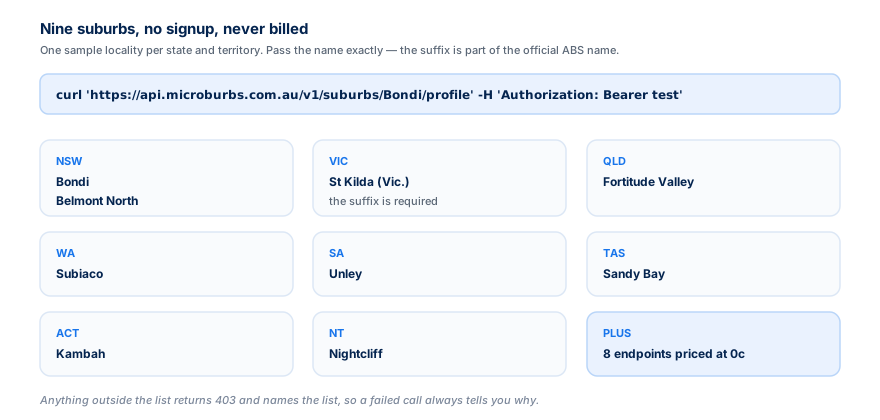
curl 'https://api.microburbs.com.au/v1/suburbs/Bondi/profile' -H 'Authorization: Bearer test'
That is the whole of it. The sandbox key is the literal word test. No signup, no credit card, no trial clock, and it is never billed to anyone. It exists so you can find out whether our data is any use to you before you talk to us.
What the free sandbox covers
The sandbox is deliberately narrow in coverage and complete in capability. You get the real endpoints returning real data — just for a fixed sample.
Nine suburbs, one per state and territory:
- Bondi (NSW) · Belmont North (NSW) · St Kilda (Vic.) · Fortitude Valley (QLD)
- Subiaco (WA) · Unley (SA) · Sandy Bay (TAS) · Kambah (ACT) · Nightcliff (NT)
Pass the name exactly as written — the suffix is part of the official ABS name, so St Kilda (Vic.) works and St Kilda returns a 403. That 403 names the allowed list, so you are never left guessing why a call failed.
There is also one sample property per state, addressed by GNAF id, for the property-level endpoints.
Eight endpoints that cost nothing, ever
Separate from the sandbox: eight of our endpoints are priced at zero for everyone, on any key. They are the ones you call constantly while building — resolving a suburb name, resolving an address to a GNAF id, listing what regions and fields exist. Charging for those would mean charging you to find out what to ask for.
The rest are priced per call in cents, published in full on the rate card. The median endpoint is 10c and the most expensive is $2.05.
What the sandbox is not
Worth being direct, because a sandbox that oversells itself wastes your afternoon.
It is not national coverage. Nine suburbs is enough to build and demo an integration, not to evaluate data quality across the country. A handful of endpoints — the suburb finder search and address lookup — are outside the allowlist entirely and will 403 on the sandbox key.
What it is genuinely good for: wiring up the integration, shaping your UI against real response bodies, checking the fields you need actually exist, and showing a working proof of concept to whoever has to approve the spend.
The response shape, so you can code against it
Every priced endpoint returns the same envelope. Branch on whether data is null:
{"data": {...}} — or — {"data": null, "available": false, "reason": "...", "message": "..."}
Both are HTTP 200. No data is not an error, and it is never returned as a zero. Beyond that: 402 means out of credit, 403 means outside the sandbox allowlist, 429 means rate limited.
Every response also tells you what it cost — X-Cost-Cents, X-Spent-Cents and X-Remaining-Cents — so you can build a budget guard rather than reading it off an invoice later.
Free for AI agents too, via MCP
The sandbox key works over MCP as well, which means you can point Claude, Cursor, Zed or VS Code at our data and ask it questions without an account. Same key, same nine suburbs.
The endpoint is https://api.microburbs.com.au/mcp, it speaks Streamable HTTP, and authentication is the same bearer header — there is no OAuth step. All 174 tools are generated from the same spec as the REST API, so what you can call in code you can ask for in a conversation. Setup for each client is in the MCP guide.
When you outgrow it
The only thing that changes is the key. Same endpoints, same response shapes, same code — the allowlist simply stops applying and you get every Australian address and locality instead of nine suburbs.
It is prepaid and per call: no minimum, no monthly commitment, no contract, and calls stop at zero rather than quietly running into an overage. Mint a key at developer keys, or start at API access if you do not have an account yet.
And if you would rather not build anything at all, AI Chat and the Property Finder are the same data with the engineering already done.
Frequently Asked Questions
Is the free Australian property data API really free?
Yes. The sandbox key is never billed, and there is no card and no signup. Separately, eight endpoints are priced at zero on every key, including paid ones.
Why only nine suburbs?
Because the alternative to a narrow free tier is no free tier. Nine suburbs — one per state and territory — is enough to prove an integration works against real data, which is what a sandbox is for.
Do I need an account to try the MCP server?
No. The same sandbox key works over MCP, so you can connect an assistant and ask questions about the nine sample suburbs before signing up for anything.