


Most property data vendors publish a page of adjectives. Comprehensive. Granular. Real-time. None of it tells you whether the thing will work for what you are building, and you usually discover the answer after the contract is signed.
Below are nine questions worth asking any Australian property data vendor before you commit. They are the ones whose answers actually change your architecture or your bill. We have answered each for ourselves, plainly, including where the answer is unflattering — but the point is to take the list to whoever you are evaluating, us included.
1. Can I see the full endpoint list without talking to sales?
If the reference is behind a demo request, you cannot scope your build, and you cannot estimate what it costs. You are being asked to commit before you can evaluate.
Ours: the complete endpoint reference is public and needs no login, and the machine-readable OpenAPI spec is downloadable so you can grep it rather than click through it.
2. What does one call cost, and is that published?
"Contact us for pricing" means the price depends on what they think you will pay. For a metered API you want a rate card you can read before you write a line of code.
Ours: per endpoint, in cents, published in full. The median endpoint is 10c, the most expensive is $2.05, and eight cost nothing.
3. Is it address-level, or just suburb averages?
This is the question that separates products, and the marketing rarely makes it obvious. A suburb median cannot tell you about a specific title — its zoning, its flood overlay, what the neighbours sold for.
Ours: both. Suburb and locality metrics, and property-level data keyed by GNAF id for every Australian address.
4. What happens when there is no data?
This one quietly determines how much error handling you write. Some APIs 404. Some return an empty object you have to guess at. Some return zero, which is the dangerous one, because zero looks like a fact.
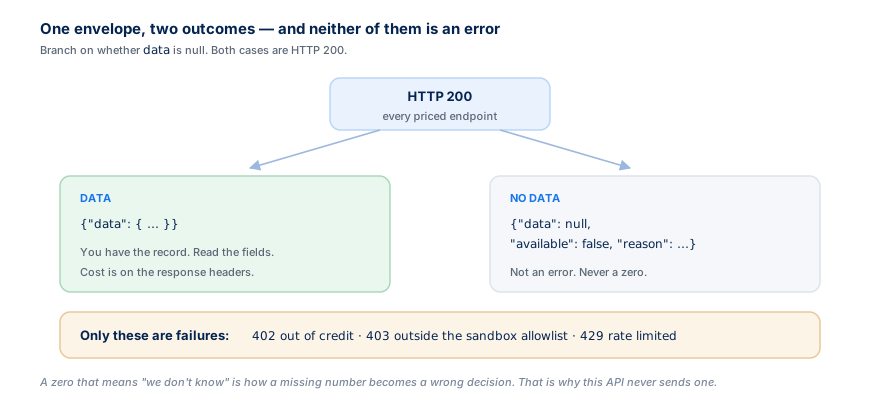
Ours: every priced endpoint returns the same envelope, and both cases are HTTP 200 — branch on whether data is null:
{"data": {...}} or {"data": null, "available": false, "reason": "...", "message": "..."}
No data is not an error, and it never comes back as a number.
5. How do I know what a call cost me, at the time it happened?
If spend only appears on a monthly invoice, you cannot build a budget guard, and you find out about a runaway loop in arrears.
Ours: every response carries X-Cost-Cents, X-Spent-Cents and X-Remaining-Cents. Calls stop at zero rather than rolling into an overage. There is also an X-Request-Id to quote if you need to ask us about a specific call.
6. Can I try it properly before paying?
A trial that requires a credit card and a sales call is not a trial. What you want is to run your real integration against real responses.
Ours: the sandbox key is the literal string test — no signup, no card. It covers nine sample suburbs, one per state and territory, plus one sample property per state. It is never billed. Anything outside that list returns 403 naming the list, so you always know why.
Be honest with yourself about what a sandbox proves. It proves the integration works and the response shapes are what you expected. It does not prove national coverage — for that you need a key.
7. What may I actually do with the data?
Ask specifically about caching, redistribution, derived products and whether you may show the data to your own customers. These terms differ far more between vendors than the data does.
Ours: the API Terms are the authority — read them rather than infer from a sales conversation. The short version is that it is built for real-time, user-driven requests, not for bulk harvesting into your own copy of the database.
8. How often does it update, and update from what?
"Real-time" is doing a lot of work in most vendor copy. The useful question is what the date attached to a given number actually means.
Ours: the pipeline runs daily across 90M+ property records. That describes the pipeline, not a promise that every underlying observation is from today — a sale still has to settle and be recorded. Ask us for the date on any specific measure and you will get it.
9. Can an AI agent use it, or only a developer?
Increasingly this decides how fast you can ship. If the only integration path is hand-written HTTP calls, every assistant-shaped use case becomes a project.
Ours: the same API is exposed as 174 MCP tools, generated from the same spec so they cannot drift apart, listed in the official MCP Registry. Same key, same per-call pricing — MCP is a transport, not a separate product. See the MCP guide.
The question behind all nine
Every item above is really asking the same thing: can I find this out without asking a salesperson? A vendor confident in their product publishes the endpoint list, the prices and the terms, and lets you test before you pay. One that does not may still have excellent data — but you will be finding out after you have committed.
If you want to run the list against us, start at API access or go straight to the reference.
Frequently Asked Questions
What is a fair price for property data in Australia?
There is no single answer, because the products differ so much in grain. The more useful comparison is cost per useful answer at the grain you need — a cheap suburb average is expensive if your product needs address-level detail.
Do I need a contract or a minimum spend?
Ask every vendor, because it varies widely. Ours is prepaid and per call, with no minimum and no monthly commitment; the published rate card is what you pay.
How do I test coverage for my own use case?
Take ten addresses or suburbs you already know well, including two you expect to be difficult, and run them through the free tier. Coverage claims are national; what matters is the fields you need for the places you care about.